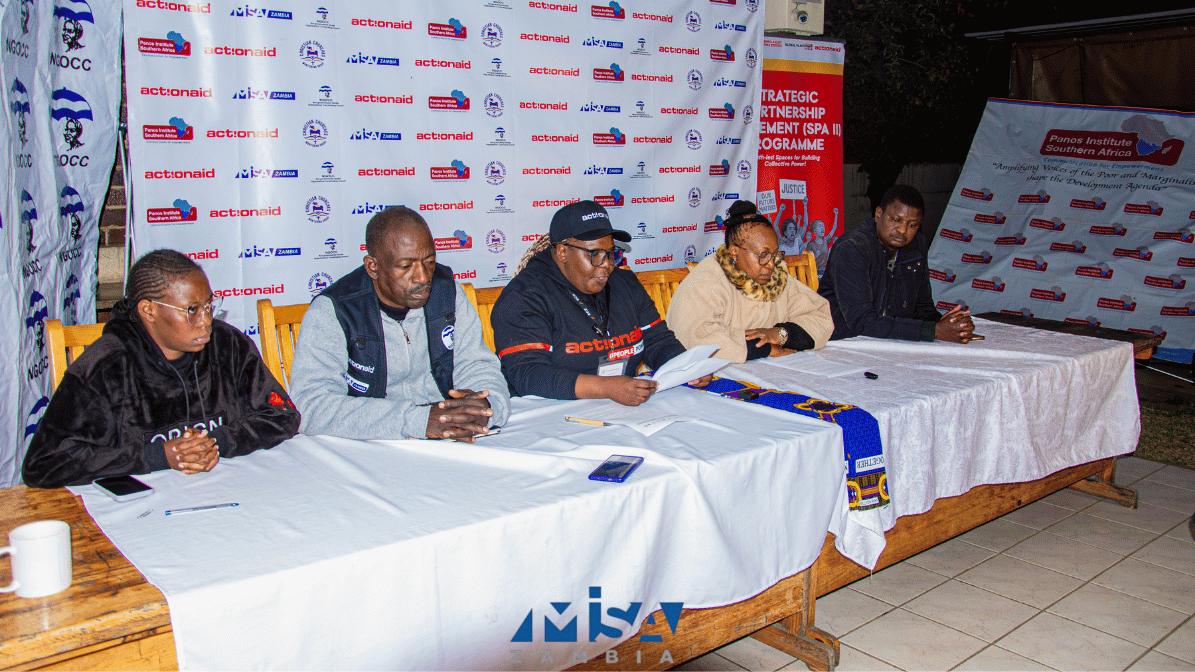
THIRD PRESS STATEMENT BY THE ZIKO LATHU CONSORTIUM AND THE GLOBAL PLATFORM NETWORK AS ZAMBIA VOTES – DELIVERED ON 13TH AUGUST 2026, AT THE GLOBAL PLATFORMxzsa
Good evening, distinguished colleagues of the press, ladies and gentlemen.
Welcome to the final media briefing of the day by the Ziko Lathu Consortium, as we present our latest preliminary assessment of the 13 August 2026 General Elections, based on information received and analysed throughout the day.
The Ziko Lathu Consortium comprises five civil society organisations: ActionAid Zambia, Panos Institute Southern Africa (PANOS), the Non-Governmental Gender Organisations’ Coordinating Council (NGOCC), Media Institute of Southern Africa (MISA) Zambia, and Young Women in Action.
As at 21:00 hours, the Consortium has continued to receive, process and analyse reports from its election monitoring mechanisms, building on the over 100 incident reports and more than 1,200 checklist submissions recorded earlier in the day. These reports provide important insights into the conduct of polling, the close of voting, and the commencement of counting across monitored locations.
Highlight if action was taken on the issues we raised in the morning or not.
POLLING STATION ISSUES AND INCIDENT NOTES
1. Closing of Polling Stations
Generally, the majority of monitored polling stations closed at 18:00 hrs, with voters who were already in queues at closing time allowed to cast their ballots. Counting commenced thereafter in several locations.
We continue to closely monitor the Polling stations which remain open due to various reasons including late opening. It is our hope that the voting will conclude soon and transition into counting to reduce anxiety among members of the public.
2. Disruptions and Suspension of Electoral Process
Operational and security-related disruptions were observed at some polling stations during voting and counting. For example, at Chipata Day Secondary polling station in Eastern Province, a power outage was reported after counting had commenced. Similarly, at Muchini Primary Polling Station, the lack of bulbs left people using phones for voting. In Chambishi Constituency at Tata Waluse polling station voting was suspended following violence associated with the delayed opening of a polling station.
Such disruptions require appropriate contingency measures to ensure that counting remains transparent, observable and uninterrupted, and that electoral materials and results are safeguarded. What makes this incident. It is particularly concerning that similar incidents were reported during the 2021 General Elections, suggesting that lessons from previous electoral processes may not have been sufficiently incorporated into current operational planning and preparedness.
3. Electoral Interference, Violence and Security Incidents
Reports of electoral interference, intimidation and violence were received from several locations. In Kanyama, suspected political actors reportedly caused disturbances and allegedly demanded voters’ cards and NRCs from voters in queues, contributing to confusion and delays in the commencement of counting. Concerns were also raised regarding the reported absence of relevant election officials and accountability documentation.
Other serious incidents were reported in Kalomo, where a former District Commissioner was allegedly involved in vote buying, followed by unrest and a shooting in which two people were reportedly injured. In Nega Nega, a citizen was reportedly seriously injured, while in Lundazi, an individual was reportedly assaulted by police.
Such incidents raise serious concerns regarding electoral integrity, transparency, accountability and the security of voters. Violence, intimidation and interference can prevent or discourage citizens from freely exercising their democratic rights, potentially resulting in voter disenfranchisement and undermining public confidence in the electoral process.
4. Low Voter Turnout
Low voter participation was reported in some monitored locations. For example, at Limulunga Primary School in Western Province, no voter turned up at the polling station as at 13:40 hrs.
5. Inadequate Electoral Materials
Reports were received of inadequate electoral materials during the counting and results management process. For example, at Kabulonga Boys Secondary School, concerns were reported regarding the availability of trays, while at polling stations at UNZA and in Kabulonga, envelopes required for sealing ballot papers were unavailable.
We are also concerned about the development at the University of Zambia (UNZA) that took place after the close of the Polling Stations. It is our hope that the impasse is resolved promptly.
As stated earlier in our Statements, this reflects inadequate preparations on the part of the Electoral Commission of Zambia (ECZ).
6. Interference of Ziko Lathu Platform
While we acknowledge that unlike in 2021, the Country has not experienced widespread internet interference, our Ziko Lathu online platform was taken down for the larger part of the afternoon. We reiterate our call for an enabling environment for all stakeholders in the digital spaces during this critical time.
A CALL TO ACTION
As voting concludes and the country transitions to counting, tabulation and announcement of results, the Ziko Lathu Consortium calls on all electoral stakeholders to uphold the integrity, transparency and peaceful conclusion of the electoral process.
We call on:
1. The Electoral Commission of Zambia (ECZ) to ensure that counting and results tabulation are conducted transparently, consistently and in accordance with established electoral procedures; to promptly address reported disruptions; and to ensure that every lawfully cast vote is accurately accounted for.
2. The Zambia Police Service and other security actors to maintain public order in a professional, impartial and proportionate manner, protect voters, electoral officials, monitors and other stakeholders, and promptly investigate reported incidents of violence, intimidation and electoral interference.
3. Political parties, candidates and their supporters to exercise restraint, refrain from violence, intimidation, misinformation and premature declarations of results, and use established legal and electoral dispute-resolution mechanisms to address grievances.
4. Citizens to remain peaceful and vigilant, avoid spreading unverified information, and respect the counting and results-management process.
The Consortium further calls for particular attention to incidents that may have resulted in voter disenfranchisement or disruption of voting, to ensure that affected citizens’ democratic rights are protected in accordance with the law.
As the process moves into the critical results phase, transparency, accountability and timely communication will be essential to maintaining public confidence in the credibility of the 2026 General Elections.
I THANK YOU.
On behalf of the consortium;
1. Action Aid Zambia
2. MISA Zambia:
3. NGOCC
4. Panos Institute Southern Africa
5. Young Women in Action