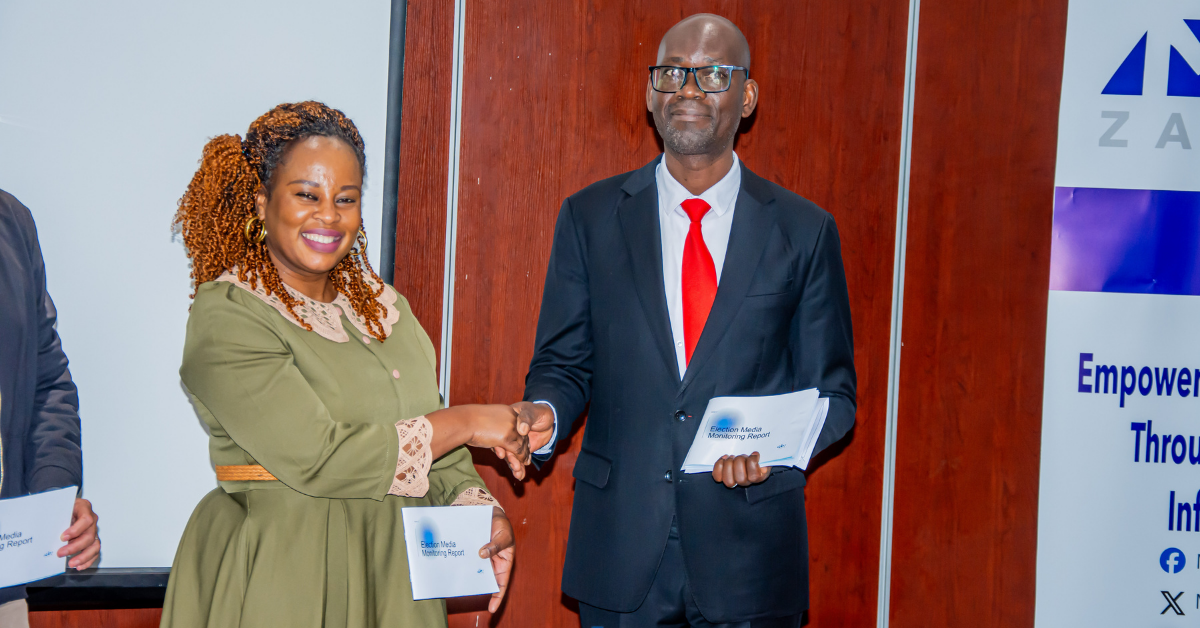
MISA Zambia has launched the third and final election content monitoring report, revealing that print media dominated election coverage during the 2026 general election campaign.
Speaking during the launch, MISA Zambia Chairperson, Lorraine Mwanza Chisanga, said the report builds on the findings of the first two assessments and provides a comprehensive evaluation of media performance during the peak of the election campaign.
Mrs. Chisanga urged media organizations to uphold the highest standards of professionalism by providing balanced, fair, accurate and inclusive election coverage that strengthens democracy.
Meanwhile, Ministry of Information and Media Permanent Secretary, Thabo Kawana, in a speech read on his behalf by the Director Press and Media Development, Morden Mayembe, urged journalists to strengthen investigative reporting, saying political violence is often planned and can be detected before it occurs.
Mr. Mayembe said some violent incidents are deliberately orchestrated for political gain, warning that such actions have the potential to trigger retaliatory violence if misinformation is allowed to spread unchecked.
He urged journalists to verify politically sensitive information before publication and called on citizens to avoid speculating on election outcomes, saying the electoral process should be allowed to unfold through voting.
“Two people cannot move together unless they agree so if you see a mob attack politician, or an opponent, there was planning that took place there and if you do investigative Journalism, you’ll get to know of these plans early enough, while in the planning phase so that you can be able to disrupt such acts”. He said.
And MISA Zambia, National Director, Austin Kayanda, said the monitoring reports are intended to strengthen professional journalism by providing evidence-based findings that can help improve the quality of election reporting and contribute to peaceful, credible and transparent elections.
The report revealed that UPND was the most visible political actor, accounting for 27% of the coverage, more than three times the share of any other individual actor shown. Its coverage was mostly positive, with 64% of stories in which UPND was the main actor coded positively. Coverage of other political actors was more mixed, with Tonse Alliance recording the highest negative share among those shown (34%).
Single-sided reporting continued to dominate the media coverage for the entire duration of monitoring, starting at 59% in Wave 1 and ending at 65% in Wave 3. Around one in five stories presented more than one side, while relatively few went further by giving those criticized or accused an opportunity to respond.
Across the three waves, fewer than one in ten stories had a woman as the main actor, compared with 85% where the main actor was male. Women’s representation as the main actor fell from 13% in Wave 1 to 9% in Wave 3. Their wider presence in the news was also limited by Wave 3, women were directly quoted or featured in 17% of election stories.