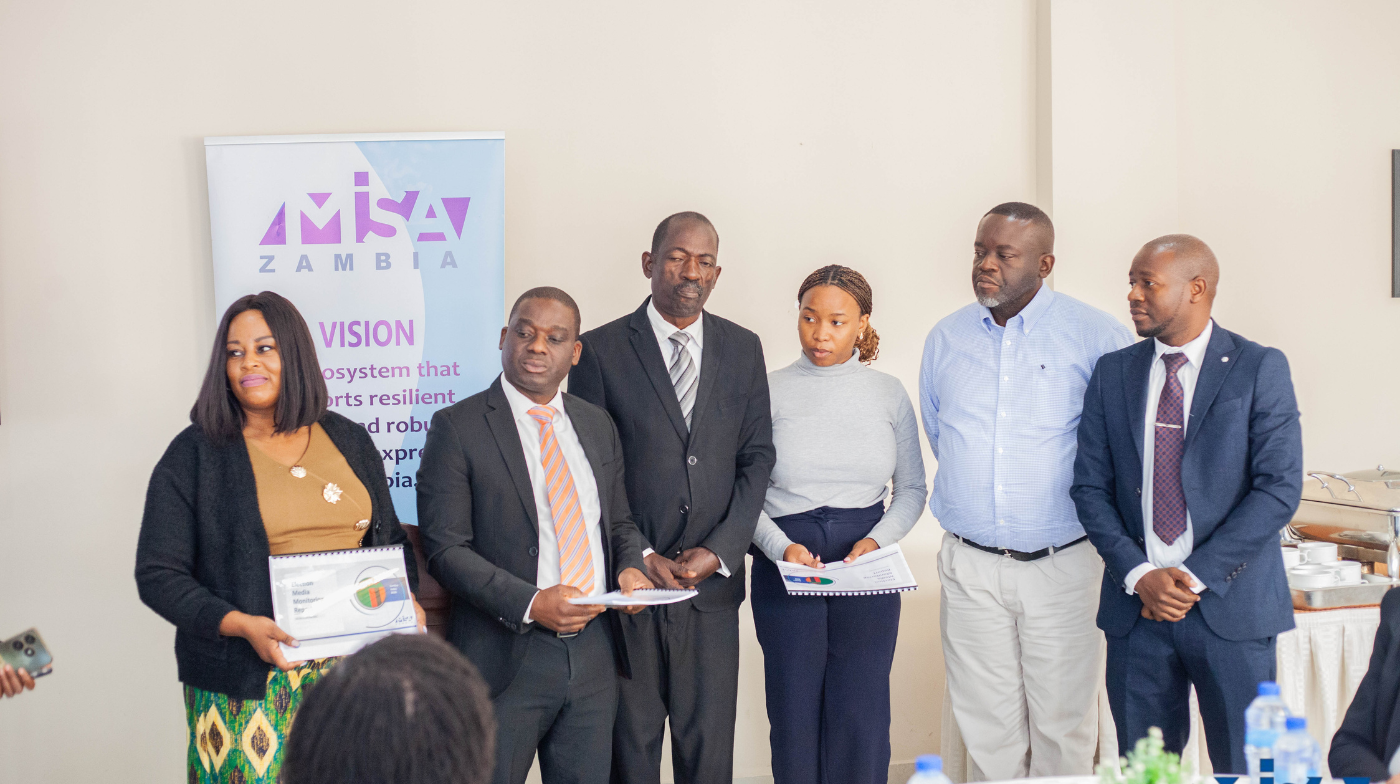
MISA Zambia has launched its first Electoral Content Monitoring Report aimed at promoting ethical, balanced and professional media coverage ahead of the August 2026 General Elections.
Speaking during the launch event in Lusaka, MISA Zambia Chairperson Lorraine Mwanza Chisanga said the report was designed to support constructive dialogue among key stakeholders and strengthen democratic participation through evidence-based analysis of election coverage.
Mrs. Chisanga said media monitoring plays an important role in assessing whether the media is fulfilling its democratic responsibility of providing citizens with accurate, balanced and impartial information during electoral processes.
“By generating evidence-based findings, media monitoring helps stakeholders move beyond perceptions and assumptions and instead engage on the basis of facts and data,” she said.
She noted that free, fair and credible elections depend on citizens having access to timely, accurate and impartial information and emphasized the need for continuous assessment of media performance during election periods.
“The findings that will be presented today should therefore be viewed as a resource for learning and improvement. They provide an opportunity for reflection on what is working well and where gaps may exist,” Mrs. Chisanga added.
Meanwhile, MISA Zambia National Director Austin Kayanda said the report was not intended to criticize or single out any institution but rather to encourage professionalism and accountability in election reporting.
“The report launched today is not intended to criticize or single out any institution. Rather, it is a constructive tool that seeks to promote professionalism, accountability, ethical journalism, and continuous improvement in election reporting,” Mr. Kayanda said.
Mr. Kayanda further noted that credible elections are strengthened by the availability of accurate, balanced, fair and inclusive information. He called on all stakeholders to continue supporting media freedom, freedom of expression and access to information as critical pillars of democratic governance.
The report was produced under the Election Content Monitoring Project, implemented by MISA Zambia with support from BBC Media Action and funding from the National Democratic Institute (NDI). It analyzed election-related content published between June 1 and June 12, 2026 across 14 media outlets drawn from the public, private and community media sectors, including print, radio, television and online platforms.
Among the key findings, the report revealed that the United Party for National Development (UPND) was the most featured actor, appearing as the primary subject in 20.9 percent of monitored stories. Government actors accounted for 12.7 percent of coverage, while other political parties featured in 10.6 percent of stories. Independent candidates appeared in 8.6 percent of stories, while the Electoral Commission of Zambia (ECZ) accounted for 8.3 percent.
The report further found that citizens, civil society organisations and traditional leaders received comparatively less attention as primary subjects of election coverage.
On gender representation, the findings showed a significant imbalance in the visibility of actors featured in election-related content. Men overwhelmingly dominated coverage, appearing as the main actor in 84.1 percent of monitored stories. Women appeared as the primary subject in only 12.7 percent of stories, while mixed-gender representation accounted for 3.2 percent.
Women’s voices were also largely absent from election coverage. Only 20.4 percent of monitored stories directly quoted or featured a woman, while 79.6 percent contained no female voice. The report noted that women were not only less visible as primary subjects but were also underrepresented as sources and contributors to public discourse.
The monitoring exercise further established that election coverage was largely neutral, with 53 percent of stories coded as neutral and only 9 percent coded as negative. This suggests that most reporting focused on describing events and developments rather than overtly criticizing political actors.
However, the report found that balanced reporting remains limited across monitored content. A majority of stories (59 percent) presented only one side of an issue, while 39 percent included more than one viewpoint. Only 7 percent of stories provided multiple perspectives and offered an opportunity for those criticized or accused to respond.
Despite these challenges, the report found that the media generally performed well in providing information relevant to voters. Nearly all monitored stories (91.9 percent) contained content that could help citizens understand electoral issues, political actors and campaign developments, thereby supporting informed participation in the democratic process.
MISA Zambia says the findings will contribute to ongoing efforts to strengthen ethical journalism, improve the quality of election reporting and promote a more informed electorate ahead of the 2026 General Elections.