Home 9 Access to information 9 Access to Information Brief podcasts

Access to Information Brief podcasts

25 Aug, 2020
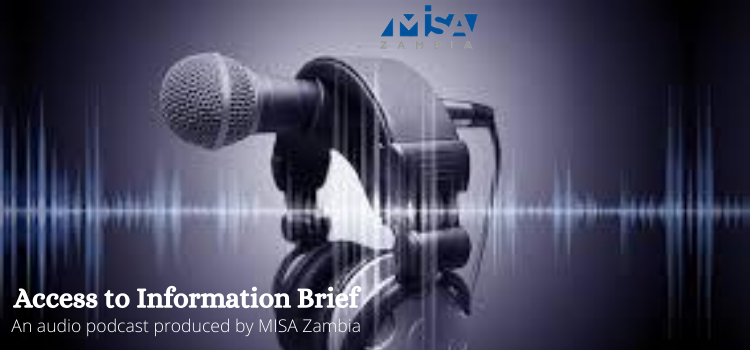
The Access to Information (ATI) Brief podcast is a 5-minute audio series aimed at raising awareness on Zambia’s Access to Information Bill.

The Access To Information (ATI) Brief is a 5-minute audio series aimed at raising awareness on Zambia’s Access to Information Bill. the podcast series is produced by MISA Zambia. The Access to Information Bill is popularly known as ATI Bill.

Zambia has over the last decade struggled to enact the said Bill regardless of various commitments from different governments to have the Bill enacted.

This first episode focuses on the history and benefits of the ATI Bill to the government and the general citizenry of Zambia.

Listen to the first episode below;
About MISA

The Media Institute of Southern Africa (MISA) was founded in 1992. Its work focuses on promoting, and advocating for, the unhindered enjoyment of freedom of expression, access to information and a free, independent, diverse and pluralistic media.

Share this

Related news

Misa Launches Third Election Content Monitoring Report

Misa Launches Third Election Content Monitoring Report

MISA Zambia has launched the third and final election content monitoring report, revealing that print media dominated election coverage during the 2026 general election campaign. Speaking during the launch, MISA Zambia Chairperson, Lorraine Mwanza Chisanga, said the...

MISA Zambia Launches Digital Rights and Public Service Broadcasting

MISA Zambia Launches Digital Rights and Public Service Broadcasting

The Media Institute of Southern Africa Zambia Chapter, MISA Zambia, today launched two reports aimed at assessing the state of digital rights and public service broadcasting in the country. The Digital Rights Report and the Public Service Broadcasting Scorecard Report...

MISA welcomes draft African Guidelines on Data Access

MISA welcomes draft African Guidelines on Data Access

MISA welcomes the draft African Guidelines as a significant step towards ensuring transparency and accountability in data collection, processing, storage, and access, in line with regional and international human rights standards. The Guidelines are appropriately...